Look at your car. It’s a marvel of engineering—powerful engines, advanced computers, and luxurious interiors. Yet, all of that technology relies on four patches of rubber, each no bigger than the palm of your hand, touching the road.
If you have ever wondered, “What actually is a tyre, and why is it so complicated?”, you are in the right place.
In 2026, tyres are no longer just “donuts” of black rubber. They are highly sophisticated technical components designed to save your life every time you drive. This guide will break down everything you need to know about the most underrated part of your vehicle.
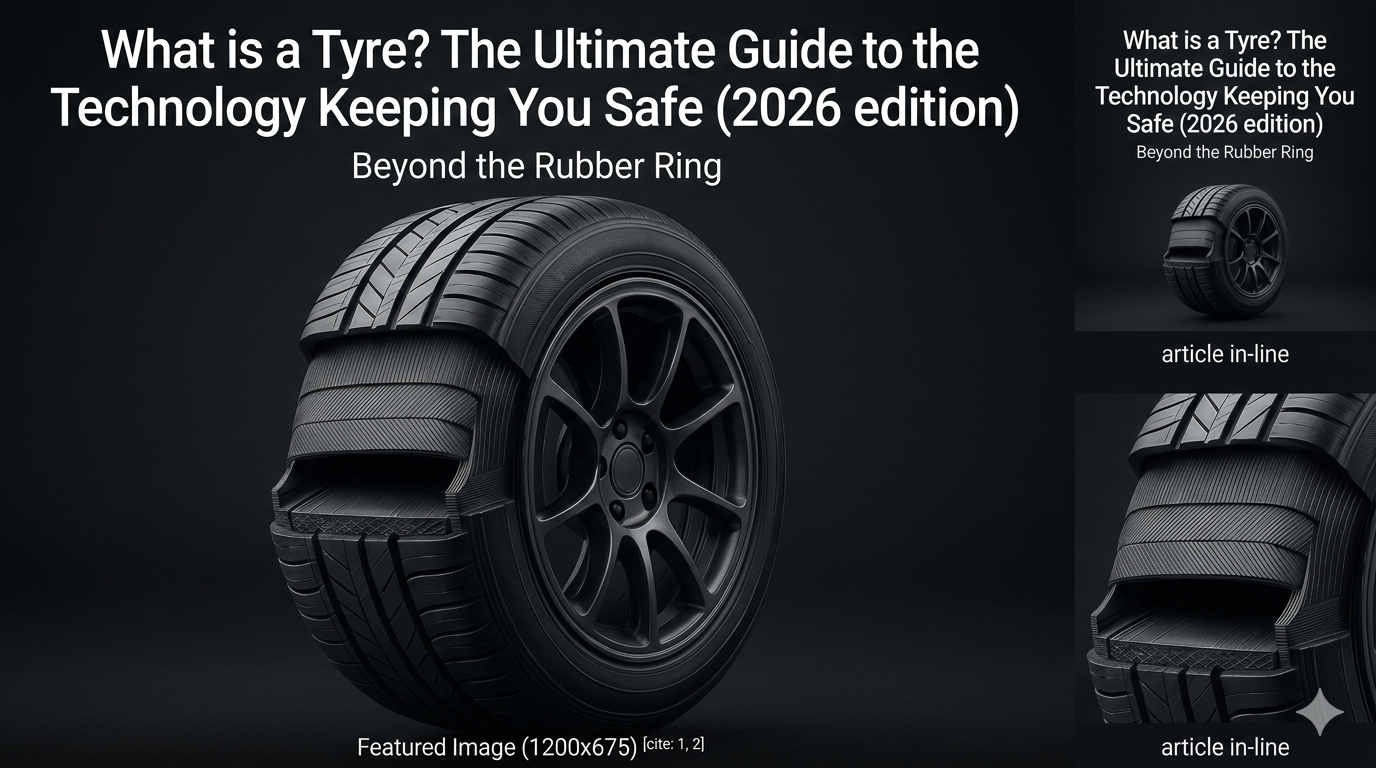
What is a Tyre? Beyond the Rubber Ring 2026
A modern pneumatic tyre flexing to absorb road shock. what is a tyre beyoud the rubber ring
At its most basic level, a modern car tyre is a pneumatic (air-filled) flexible envelope made of rubber, fabric, and wire, which fits around the wheel rim.
It is the only point of contact between your vehicle and the ground. It doesn’t matter if you are driving a budget hatchback or a high-speed electric supercar; if your tyres fail, the car fails.
The 4 Critical Jobs of a Tyre
Why do we use these complicated rubber structures instead of solid metal wheels like older trains? A modern tyre must perform four essential functions simultaneously:
1. Supporting the Load
The tyre itself doesn’t hold up the car—the air inside it does. The tyre structure is just the container for that high-pressure air, supporting tons of metal, passengers, and cargo.
2. Absorbing Shock (Cushioning)
Roads are never perfect. If you drove on solid wheels, your teeth would rattle out of your head at 60 km/h. The air acts as a spring, and the rubber flexes to absorb bumps, potholes, and vibrations, giving you a smooth ride.
3. Transmitting Forces (Grip)
This is the most crucial safety feature. The tyre must grip the road so that when you press the accelerator, you move forward; when you press the brake, you stop; and when you turn the steering wheel, the car turns. Without grip, you have zero control.
4. Steering Direction
When you turn the wheel, the tyres change angle. Their grip on the asphalt forces the heavy vehicle to change direction.
The Four Pillars Of Tyre Fuction
Anatomy of a Tyre: What’s Inside?
Many people think a tyre is just molded rubber. That couldn’t be further from the truth. A modern tyre is a complex sandwich of over 20 different materials.
what is a tyre beyond the rubber ring
Here is a breakdown of the critical layers:
1. The Tread (The Contact Patch)
This is the outer layer you see and touch. It uses a special rubber compound designed for high grip and high wear resistance. The patterns (grooves) are engineered to channel water away to prevent skidding (hydroplaning) in the rain.
2. The Sidewall (The Spine)
The side of the tyre that features the brand name and size details. It is designed to be flexible to absorb shocks, but stiff enough to stop the tyre from collapsing while turning.
3. Body Plies (The Skeleton)
Underneath the rubber are layers of fabric cords (polyester or rayon) coated in rubber. These give the tyre its strength and hold the air pressure in.
4. Steel Belts (The Armor)
Running under the tread are layers of steel wire mesh. These belts stabilize the tread area, preventing punctures from nails and ensuring the tyre stays flat on the road for maximum grip.
5. The Bead (The Anchor)
This is a thick loop of high-strength steel wire coated in rubber. It sits tightly against the metal wheel rim, ensuring the tyre doesn’t pop off the wheel, even under extreme cornering forces.
Tread, Steel Belts, Body Ply, Sidewall, and Bead. This looks very technical and builds trust.
Why One Tyre Doesn’t Fit All
Just like you wouldn’t wear sandals in the snow or heavy boots on the beach, different driving conditions require different tyres.
Summer Tyres: Made of harder rubber that handles heat well and provides maximum grip on dry and slightly wet roads.
Winter Tyres: Made of softer rubber that stays flexible in freezing temperatures, featuring deep grooves for snow.
All-Season Tyres: A compromise between the two, suitable for moderate climates but not master of either extreme.
As we move through the seasons, it is vital to ensure your tyres are ready for the challenge. Especially with the increasing heatwaves we are seeing lately.
Vital Safety Information for Drivers
Don’t ignore the changing seasons. Heat can destroy a tyre from the inside out. Before the summer hits its peak, you need to read this urgent advisory.
Tyre technology isn’t standing still. The future is “smart” and sustainable.
EV-Specific Tyres: Electric vehicles are heavier and have instant torque (power). New tyres are being developed specifically to handle this extra weight and reduce road noise, which is more noticeable in silent electric cars.
Smart Tyres: High-end tyres now come with embedded sensors (RFID chips) that talk to the car’s computer, providing real-time data on temperature, pressure, and tread wear.
Sustainable Materials: Major manufacturers are moving away from petroleum-based rubber and experimenting with materials derived from dandelions, rice husks, and recycled plastic bottles.
The Most Critical Tyre Tip: Air Pressure
You now know what a tyre is, but the most important thing you can do as a driver is maintain the air inside it.
Remember, the AIR carries the load. If your pressure is too low, the tyre’s internal structure (the skeleton mentioned earlier) will flex too much, overheat, and eventually blow out.
How do you know if you have enough air?
Check Your Pressure Today
Correct tyre pressure is the easiest way to save fuel and prevent accidents. Do not guess; know for sure.
A tyre is not just a simple accessory; it is a highly engineered safety device. It is a complex composite of chemistry, physics, and engineering designed to keep you safe at 100 km/h.
Next time you look at your car, give those black circles a little respect. They are working harder than any other part of your vehicle.
Frequently Asked Questions (FAQs)
Q: Are tyres made of 100% natural rubber?
A: No. Modern tyres are a mix of natural rubber (from trees) and synthetic rubber (man-made polymers derived from petroleum), along with steel, fabric, carbon black, and silica.
Q: What is the difference between radial and bias-ply tyres?
A: Almost all modern car tyres are “Radial.” This means the internal ply cords run at a 90-degree angle to the direction of travel. This allows the sidewall and the tread to work independently, offering better grip and fuel economy than older “bias-ply” tyres.
Q: How do tyres grip the road?
A: They grip through friction. The rubber compound is designed to conform to the microscopic rough surface of the road asphalt, interlocking with it like Velcro on a tiny scale.
Get Moving with Siddhi Tyre
Don’t let a worn-out tyre slow you down. Experience light-speed service and professional expertise that keeps you safe on the road.
Whether you are looking for premium replacements or expert advice, we are here to help.
Fast. Reliable. Professional. Siddhi Tyre India Mart.
Drive Smarter: Tire Safety Essentials
At Siddhi Tyre, we believe an educated driver is a safe driver. Your tyres are the only point of contact between your vehicle and the road. Here is what you need to know to maintain light-speed performance:
✓Check Tread Depth: Worn tyres increase braking distance. If your tread is below 1.6mm, it’s time for a professional replacement.
✓Maintain Air Pressure: Correct PSI improves fuel efficiency by up to 3% and prevents uneven wear.
✓Alignment Matters: If your car pulls to one side, your alignment is off—leading to faster tyre degradation.
“Quality is never an accident; it is always the result of intelligent effort.” Get the best brands and expert advice at Siddhi Tyre India Mart.
Siddhi Tyre – Professional Solutions at Light Speed.
Is Your Safety Holding on by a Thread?
The 10-second check that could save your journey.
Did You Know?
Most drivers wait until a tyre is “bald” to replace it, but performance drops by 40% long before that. At Siddhi Tyre, we don’t just sell rubber; we provide the engineering that keeps you glued to the road at any speed.
⚡ The 10-Second Test
Insert a coin into your tyre groove. If you can see the entire outer rim, your grip is compromised. Don’t guess your safety—get a Light Speed Consultation from our experts today.
Vital Safety Information for Drivers
The 2026 Summer Tyre Alert
Check Your Pressure Today