
- TL;DR: Indian drivers generally replace tyres more often due to road conditions and heat; U.S. drivers often replace based on age or mileage tied to different maintenance habits.
Key takeaway: expect different recommended replacement timelines depending on driving environment — use our Tyre Life Estimator to get a personalized replacement window based on vehicle, driving style, and local road conditions.
Tyre Lifespan Comparison: India vs USA
Average tyre lifespan comparison between Indian and American driving conditions
Typical tyre life depends on driving conditions, vehicle type, and maintenance. In India, where heat, rough urban roads, and heavy stop-and-go traffic are common, a passenger-car tyre typically lasts about 40,000–50,000 kilometers (roughly 3–5 years for a typical driver). In the USA, tyre life is often reported as roughly 25,000–50,000 miles (40,000–80,000 kilometers), which for many drivers translates to about 4–6 years depending on mileage and seasonal use.
Key Factors Affecting Tyre Durability
Indian Driving Conditions
- High ambient and road-surface temperatures in many regions that accelerate rubber aging (estimates vary by region and season)
- Variable road quality with potholes and rough patches that increase sidewall and tread damage
- Greater incidence of roadside debris and objects that cause punctures
- Urban congestion and frequent braking/acceleration that unevenly wear tread
- Monsoon-related water exposure that increases hydroplaning risk and can mask wear
American Driving Conditions
- Extensive, well-maintained highways that produce more uniform tread wear on long-distance trips
- Cold climates in northern states that can harden rubber and increase cracking risk over time
- Higher sustained speeds on highways, changing wear patterns compared with city driving
- Long highway stretches that reduce repetitive stress from braking/turning
- Seasonal tyre swaps in colder regions (winter vs. all-season), which change annual wear profiles
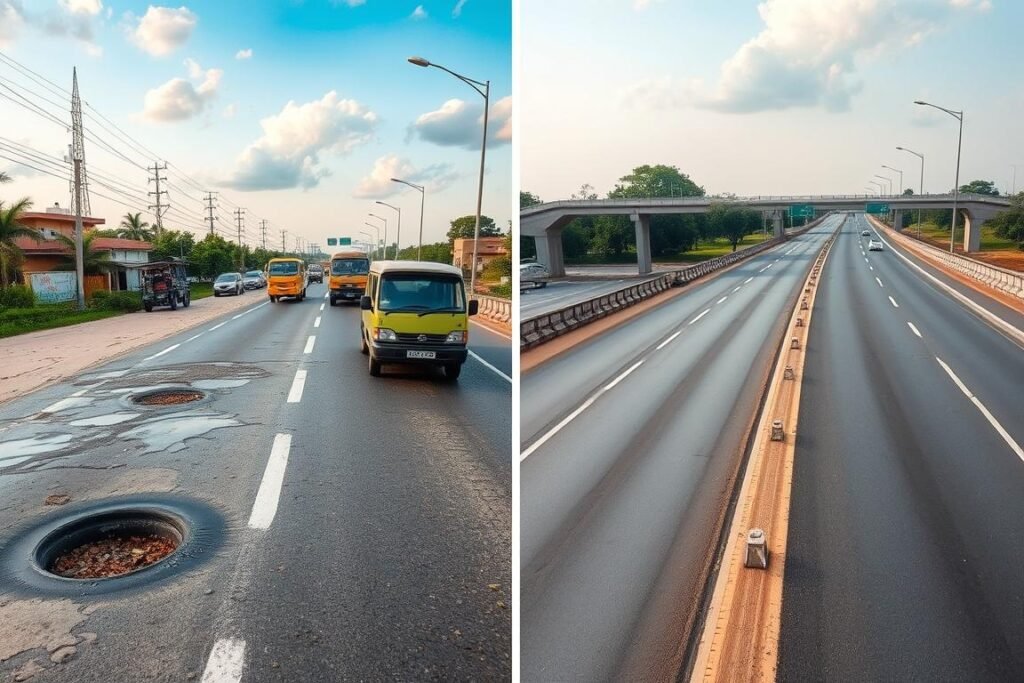
Road condition comparison: Indian streets (left) vs. American highways (right)
These environmental and usage differences materially affect replacement frequency. Industry estimates and tested averages suggest urban Indian drivers may replace tyres roughly 15–25% more often than comparable American drivers operating primarily on highways — a range that depends on vehicle load, maintenance habits, and regional climate. For trucks and commercial vehicles, harsher road conditions and higher loads in some Indian markets can further shorten tyre life and raise demand for more frequent replacement or retreading.
| Typical lifespan | India (passenger car) | USA (passenger car) |
| Distance | 40k–50k km | 25k–50k miles (40k–80k km) |
| Years (typical) | 3–5 years | 4–6 years |
| Replacement frequency vs counterpart | ~15–25% more often | Baseline (varies by use) |
Example scenarios: a city driver in Mumbai who averages short trips and faces rough stretches may hit replacement conditions in 3–4 years; a U.S. suburban commuter who does mostly highway miles may see tyres last 5–6 years. These examples are indicative — maintenance (rotation, alignment, pressure checks) and load management can change outcomes substantially.
Is it time for new tyres?
Use our free Tyre Life Estimator to get a personalized replacement window — the tool checks tread depth, manufacture date (DOT code), driving profile, and local road conditions.
Government Regulations on Tyre Safety and Replacement
Tyre Changes India vs USA Maintenance & Replacement Guide
India and the USA both maintain regulatory frameworks intended to protect vehicle safety, but they differ in specifics, enforcement, and the supporting policy environment. Below are the principal rules and practical checks drivers should know in each market.
Indian Tyre Regulations
- Minimum tread depth: 1.6 mm is the commonly cited legal minimum in many jurisdictions and aligns with international practice; drivers should confirm local enforcement details with state transport authorities.
- Manufacturing standards: Indian tyres are manufactured to Bureau of Indian Standards (BIS) specifications such as IS 15633 for pneumatic tyres for passenger vehicles — check the latest standard version with BIS for updates.
- Age guidance: There is no national legal maximum age for tyres, but manufacturers and industry bodies commonly recommend considering replacement after about 5–6 years regardless of visible tread.
- Import rules: Imported tyres must meet BIS certification and other import compliance requirements; tariff and GST rates may affect the cost of premium imported products.
- Enforcement: Roadside checks and vehicle inspections vary by state and region, so practical enforcement of tread and tyre condition standards is uneven across India.
USA Tyre Regulations
- Federal standards (DOT): Tyres sold in the U.S. must meet Department of Transportation (DOT) safety requirements; look for the DOT mark on the sidewall indicating compliance.
- Tread depth requirement: The common legal minimum is 2/32 inch (≈1.6 mm) in many states; some states or inspection programs may adopt stricter thresholds for safety.
- State variations: States may run vehicle inspection programs that include tyre checks; requirements and frequency differ by state.
- Age guidance: NHTSA and manufacturers advise assessing older tyres — many recommend replacement after roughly 6–10 years regardless of tread when ageing or damage is evident.
- Seasonal rules: Certain northern states have seasonal rules requiring winter tyres or chains during specified months or conditions.
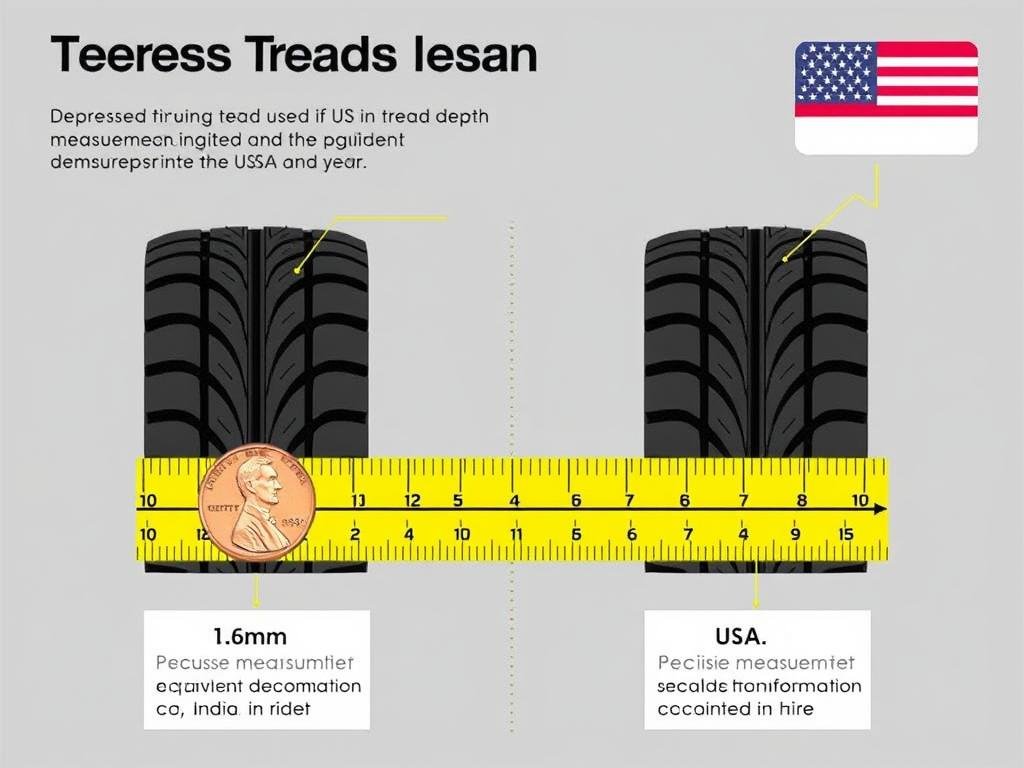
Tread depth measurement standards and techniques in India and USA
“While both countries maintain similar minimum tread depth requirements, the enforcement mechanisms and driver awareness levels differ significantly, impacting real-world compliance rates.”
Practical checks for drivers: measure tread with a gauge or use the built-in tread wear indicators, read the DOT manufacture week/year code on the sidewall to track tyre age, and perform monthly pressure checks. For quick at-home checks, a 2/32″ gauge or a simple coin test (local equivalent) helps identify tyres near legal limits.
Policy context: government support, tariff and GST rates, and trade rules affect tyre prices and the flow of imports/exports. Industry associations and manufacturers’ associations also lobby for policy support and standards alignment — for example, to improve competitiveness of domestic manufacturing and support export growth. If you manage a fleet or plan cross-border purchases, check current tariff rates and import rules to understand cost implications.
Key Differences Between Indian & US Tyres
Beyond usage patterns and regulations, tyres sold and used in India and the USA often reflect different design priorities and material choices tailored to local roads, climate, and consumer needs.
| Feature | Indian Tyres | US Tyres |
| Heat Resistance | Compounds tend to prioritize heat resistance to cope with high ambient and road-surface temperatures. | Compounds are balanced for a wider climate range; dedicated winter or all-season options are common. |
| Why it matters | Better heat resistance helps reduce rubber ageing and sidewall damage in hot regions. | Balanced compounds improve consistent wear across seasonal temperature changes. |
| Tread Pattern | Patterns emphasize durability and water evacuation for monsoon conditions and varied surfaces. | Highway-optimized tread for low rolling resistance, with season-specific options widely available. |
| Why it matters | Aggressive evacuation and chunk-resistance reduce punctures and hydroplaning in heavy rain. | Optimized patterns extend tread life at sustained highway speeds and improve fuel efficiency. |
| Sidewall Strength | Often reinforced to withstand potholes, kerb impacts, and rough patches. | Designed for ride comfort on smoother roads; sidewall constructions vary by model. |
| Load & Speed Ratings | Frequently higher load ratings to accommodate heavier loads and mixed-use conditions. | Varied ratings with many models emphasizing speed and highway stability. |
| Manufacturing Focus | Durability, puncture resistance, and cost-effectiveness are typical priorities. | Fuel efficiency, noise reduction, and comfort are often emphasized. |
Indian tyre manufacturers such as MRF, Apollo, and CEAT develop products tailored to local conditions; these firms are part of the broader Indian tyre industry that supports domestic demand and growing tyre exports. In contrast, many American and international brands in the US market focus product lines on highway performance and seasonal versatility.
Need expert advice on the right tyres?
Get personalized recommendations based on your driving conditions and vehicle type — tell us where you drive most (city, highway, or mixed) and whether you carry heavy loads.
Manufacturing Standards and Materials
Material composition differs by market. Indian tyres often include higher proportions of natural rubber and formulations optimized for heat dissipation — a response to local climate and raw materials availability. U.S. market tyres commonly use blends with higher synthetic rubber content to target longer tread life and consistent performance across seasons. These tendencies affect lifecycle, recyclability, and retreading options.
Testing and standards also differ: U.S. manufacturers comply with DOT requirements, while Indian manufacturers adhere to BIS standards (e.g., IS 15633) and other industry testing protocols. Manufacturers’ associations in both markets work with governments to align standards, improve product support, and boost competitiveness and export growth for their sectors.
Cost Analysis: Tyre Replacement Economics
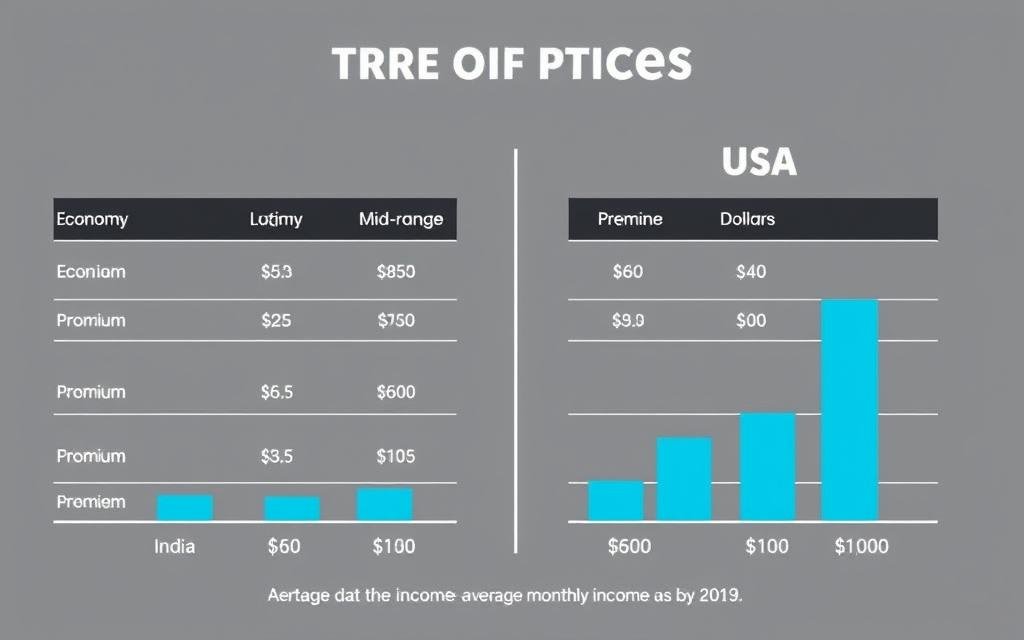
Tyre price comparison across different segments in India and USA
Tyre replacement economics differ substantially between India and the USA — both in sticker price and as a share of household income. Below are typical market price bands, followed by an illustrative lifetime cost comparison and a short note on how trade policy and the tyre industry affect prices and availability.
Indian Tyre Market Pricing
- Economy segment: ₹3,000–₹5,000 per tyre (approx. $36–$60 at current rates)
- Mid-range segment: ₹5,000–₹10,000 per tyre (approx. $60–$120)
- Premium segment: ₹10,000–₹20,000+ per tyre (approx. $120–$240+)
- Average complete set replacement: ₹20,000–₹40,000 (approx. $240–$480)
- Relative burden: represents an estimated 30–60% of average monthly urban income for many households (varies by city and year)
US Tyre Market Pricing
- Economy segment: $50–$100 per tyre
- Mid-range segment: $100–$200 per tyre
- Premium segment: $200–$500+ per tyre
- Average complete set replacement: $400–$800
- Relative burden: roughly 5–15% of average monthly income for typical households (varies by state and year)
Lifetime Cost Example (Illustrative)
Use this simple calc to see how replacement frequency affects cost-per-km:
- India example: mid-range tyre ₹7,500 each, replaced every 45,000 km → cost-per-km (one tyre) = ₹0.167/km. Over 100,000 km, replacing twice ≈ ₹15,000.
- USA example: mid-range tyre $150 each, replaced every 70,000 km → cost-per-km (one tyre) = $0.0021/km. Over 100,000 km, replacing once–twice depending on use ≈ $150–$300.
These illustrative figures show how lower unit prices in India can still translate to higher lifetime costs when replacement intervals are shorter. Truck and commercial tyre economics are more sensitive to load and road conditions and often drive higher demand for retreading or premium durable tyres.
Trade, Tariffs and Market Effects
Trade policy influences tyre prices and the competitive landscape. Tariffs, GST, and import rules affect the cost of premium imported tyres and the viability of duty-free imports or special tariff concessions. The indian tyre industry and automotive tyre manufacturers lobby for policy support to improve competitiveness and boost tyre exports. Conversely, tariff barriers can protect local manufacturing but raise consumer prices; reductions in tariff rates or duty-free imports for specific components can lower production cost and encourage export growth.
Cost Advantages in India
- Lower initial purchase price for comparable tyre models
- Affordable installation and labor costs
- Strong domestic manufacturing base that supports competitive pricing and export growth
- Wider availability of retreading and repair services
Cost Challenges in India
- More frequent replacements due to road conditions increase lifetime cost
- Tariff, GST, and import rates can inflate prices for premium imported tyres
- Fleet and truck operators face higher operating costs when roads and loads are severe
- Raw materials and global commodity rate changes can affect manufacturing costs and product pricing
For consumers and fleet managers, two actions reduce long-term cost: choose the right tyre for your primary use (city vs. highway; truck vs. passenger), and invest in routine maintenance (pressure, alignment, rotation). From a policy perspective, balanced tariff and trade rates, targeted support for manufacturers, and clear GST treatment can improve competitiveness, support export markets, and moderate retail prices.
Compare tyre prices in your area
Find the best deals and estimate lifetime cost with our calculator — filter by country, vehicle type, and price band.
Tyre Maintenance Practices and Consumer Awareness
Maintenance habits and consumer awareness are decisive factors in tyre lifespan across markets. Simple, routine care often extends tyre life more effectively than buying a premium product used without regular upkeep.
Common Maintenance Practices
India
- Pressure checks at local filling stations are common but frequency varies — aim for monthly checks and before long trips.
- Puncture repairs are widely available and cost-effective; inspect repaired tyres regularly for integrity.
- Tread rotation practices exist but are inconsistently followed; rotating every 5,000–8,000 km helps even wear.
- Wheel alignment services are less frequently used; misalignment accelerates uneven wear and reduces life.
- Awareness of tyre age and DOT/manufacture codes is growing but remains limited in some regions.
USA
- DIY pressure monitoring is common; many drivers use personal gauges or vehicle TPMS — check monthly.
- Regular rotation (typically every 5,000–8,000 miles) is widely recommended and practiced by many garages.
- Alignment services are routinely advised during tyre changes and after suspension impacts.
- Seasonal tyre changes (winter vs. all-season) are common in colder states and improve longevity.
- Digital tyre monitoring and dealer-led maintenance reminders increase proactive replacement decisions.
Quick fact: Proper maintenance — consistent pressure checks, timely rotation, and alignment — can increase tyre life materially; estimates vary, but many industry sources suggest maintenance can extend life by roughly 10–20% compared with neglected tyres.
Practical, actionable checklist for drivers (both markets):
- Check tyre pressure monthly and before long trips — follow vehicle manufacturer PSI.
- Inspect tread depth and look for uneven wear; use a tread gauge or look for tread wear indicators.
- Rotate tyres every 5,000–8,000 km (India) or 5,000–8,000 miles (USA) depending on local recommendations and driving style.
- Get alignment checked if you hit a pothole, kerb, or notice steering pull or vibration.
- Read the DOT/manufacture code to track tyre age; consider replacement or professional inspection for tyres older than 6 years.
Short case studies
- Urban India: A commuter who began rotating tyres every 6,000 km and checking pressure monthly extended tyre life by an estimated year (manufacturer and usage-dependent), reducing lifetime cost despite rough roads.
- U.S. Highway Driver: A suburban driver using TPMS and seasonal swaps preserves even tread wear and often achieves the higher end of expected lifespan for mid-range tyres.
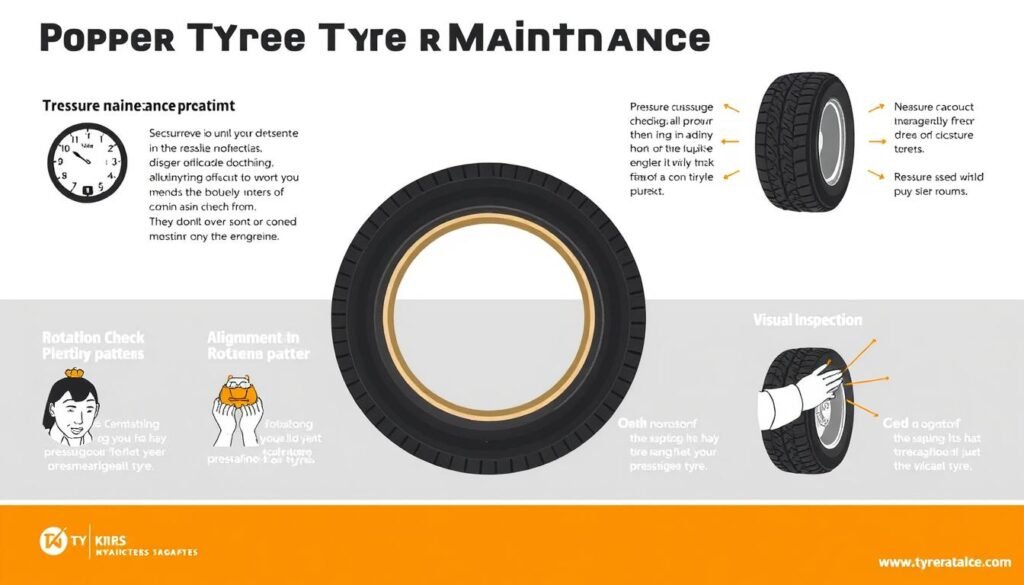
Essential tyre maintenance practices to maximize lifespan
Support for better maintenance practices — from tyre manufacturers, retailers, and government road-safety programs — raises overall awareness and demand for quality servicing. For fleet managers and truck operators, scheduled maintenance and selecting appropriate tyres for load profiles significantly reduce operating cost and downtime.
Master proper tyre maintenance
Download our region-specific maintenance checklist (India / USA) and get reminders for pressure checks, rotations, and alignments.
Frequently Asked Questions
Can I use Indian tyres in the USA?
Yes—Indian-manufactured tyres can be used in the USA if they carry the DOT marking on the sidewall, which indicates they meet U.S. federal safety standards. However, tyres designed mainly for Indian conditions may have different compound or tread characteristics and might wear differently under U.S. driving patterns (more highway miles, different temperatures). Always check the tyre’s specifications and consult a trusted tyre manufacturer or local dealer before fitting them to your vehicle.
How does climate affect tyre lifespan in India versus the USA?
Climate has a major impact. High heat and strong sunlight in many Indian regions accelerate rubber aging and can reduce useful life; monsoon conditions also increase wear from standing water and scuffing. In the USA, colder northern climates can harden rubber and promote cracking over time, while southern U.S. regions face heat-related stresses similar to India. The net effect depends on local extremes, so factor climate into your tyre choice and replacement schedule.
Are premium tyres worth the extra cost in India?
Often yes for frequent-city or long-distance drivers. Premium tyres typically cost more upfront but are engineered for longer tread life, better wet grip, and greater puncture resistance—advantages that matter on challenging roads. Compare cost-per-kilometer (price divided by expected lifespan) for economy vs. premium options to decide; the premium choice can be cost-effective if it reduces replacement frequency and improves safety.
How do I know when it’s time to replace my tyres?
Look beyond minimum legal tread depth. Replace tyres if you see: uneven wear, exposed cords, sidewall cuts or bulges, frequent pressure loss, excessive vibration, or if the tyre is old. Check the DOT/manufacture code on the sidewall to read the week/year of manufacture—many manufacturers and safety bodies recommend inspecting or replacing tyres older than about 6 years. Use a tread gauge or the vehicle’s recommended checks as part of monthly maintenance.
Why do American tyres seem to last longer than Indian ones?
Perceived longevity differences mainly reflect use and maintenance: U.S. drivers often do more highway miles on smoother surfaces, follow regular rotation and alignment schedules, and use seasonal tyre strategies. Indian roads in many areas are rougher and hotter, and maintenance practices vary — all of which can shorten tyre life. When tyres from either market are used under identical conditions with similar maintenance, performance differences narrow considerably.
Conclusion: Bridging the Gap in Tyre Maintenance
Differences in tyre change frequency between India and the USA reflect broader contrasts in road infrastructure, household economics, and driving culture. American drivers often benefit from smoother highways, regular maintenance habits, and seasonal tyre strategies that can extend tyre life; Indian drivers frequently contend with higher heat, rougher roads, and variable enforcement, which leads to different replacement needs and market demand.
Looking ahead, continued alignment of manufacturing standards, policy support for the indian tyre sector, and greater consumer education should encourage convergence in maintenance practices and product quality. Improved trade policy — balanced tariff and GST rates, clearer import rules, and targeted support for manufacturers — can also boost competitiveness and tyre exports, helping the market grow while keeping prices and product choices favorable for consumers and fleet operators.
Actionable takeaway: Select tyres for your primary use (city, highway, or truck/fleet), maintain them regularly (pressure, rotation, alignment), and replace based on tread, damage, or age. These steps deliver the greatest benefits for safety and long-term cost regardless of market.
Need professional tyre service?
Find certified tyre specialists near you — filter by country, service type, and certification to compare expected service rates and guarantees.