Introduction: Beyond the Rubber – Why Tyre Size Matters More Than You Think
Ever glanced at your tyre and seen a confusing string of numbers and letters? 🤯 You’re not alone. Most drivers consider tyre size only when it’s time for a replacement. But understanding these digits is crucial – it’s the secret language your car uses to communicate its needs for optimal performance, fuel efficiency, and most importantly, your safety on the road.
This isn’t just about fitting new rubber; it’s about mastering your vehicle’s foundation. In this ultimate guide, we’ll demystify every character on your tyre’s sidewall, transforming you from a casual driver into a knowledgeable expert. Let’s decode the code! 🔍

Imagine your tyre’s sidewall as a mini-billboard of vital information. Every car, SUV, truck, and even motorbike has a specific tyre size recommended by its manufacturer. Deviating from this can lead to poor handling, inaccurate speed readings, and even dangerous situations.
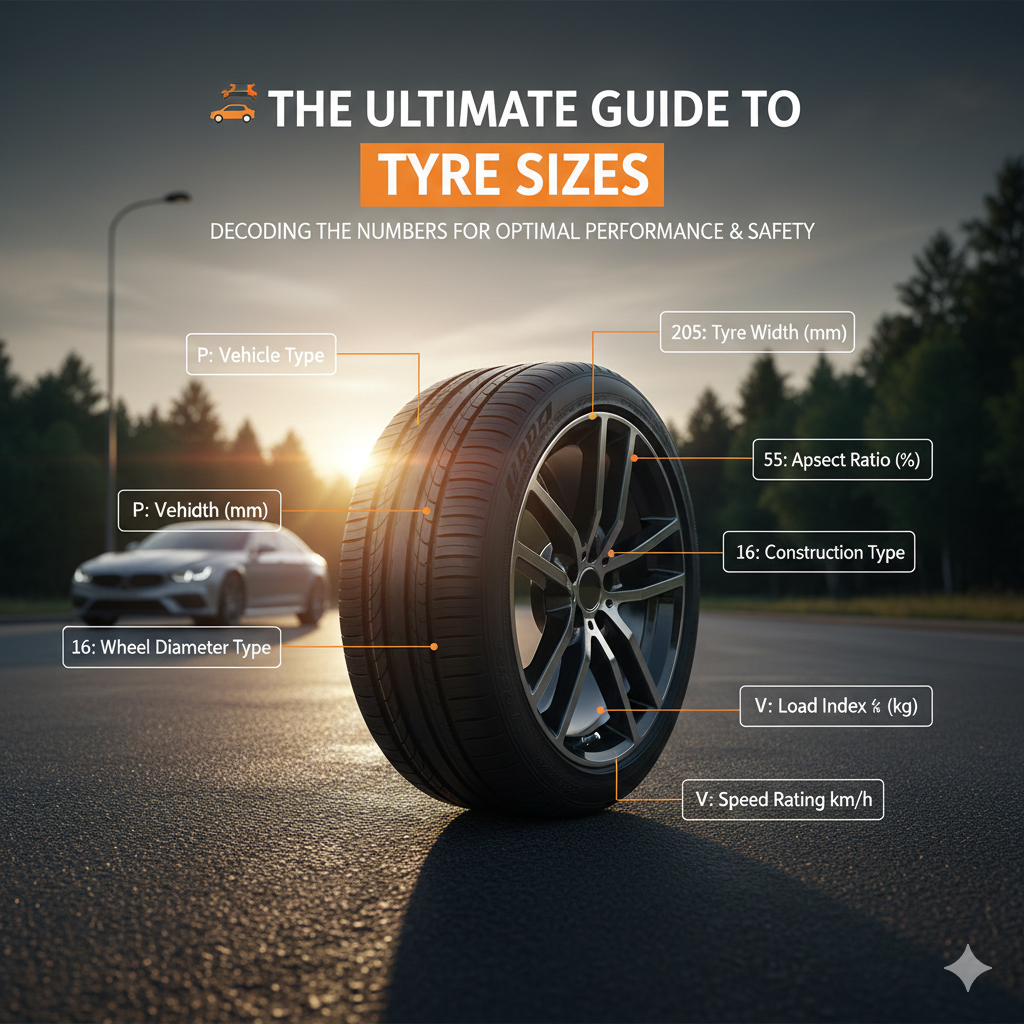
Here’s a typical tyre size code, broken down: P205/55R16 91V
Let’s unpack this, digit by digit: 🧐
A. “P” – Vehicle Type (Or Lack Thereof)
- P (Passenger): Indicates the tyre is designed for passenger vehicles (cars, SUVs, light-duty trucks).
- LT (Light Truck): For heavy-duty trucks and SUVs, often used for towing or hauling.
- T (Temporary): For spare tyres.
- ST (Special Trailer): For trailers.
- If there’s no letter, it’s often a European metric tyre, generally similar to “P” for passenger cars.
B. 205 – Tyre Width (Millimetres)
This is the section width of the tyre, measured in millimetres, from sidewall to sidewall.
- Wider tyres (larger number): Generally offer more grip (especially in dry conditions), can improve handling, but may reduce fuel efficiency slightly.
- Narrower tyres (smaller number): Can improve fuel economy, perform better in snow/slush, but might have less grip in corners.
C. 55 – Aspect Ratio (Profile Height)
This number is the tyre’s sidewall height expressed as a percentage of its width.
- How it works: If the width is 205mm and the aspect ratio is 55, the sidewall height is 55% of 205mm (approx. 112.75mm).
- Higher aspect ratio (larger number, e.g., 65, 70): Taller sidewall, generally means a softer ride, more suited for comfort and off-road.
- Lower aspect ratio (smaller number, e.g., 35, 40): Shorter sidewall, typically found on sports cars, offers sharper handling, better steering response, and a firmer ride. 🏎️
D. R – Construction Type (Radial)
This letter indicates how the tyre’s internal plies (layers of fabric cords) are constructed.
- R (Radial): The most common type today. The plies run radially across the tyre, perpendicular to the direction of travel. Offers superior stability, ride comfort, and fuel efficiency.
- D (Diagonal/Bias Ply): Older technology, plies run diagonally. Less common on passenger cars now.
- B (Belted Bias): A hybrid of bias-ply with belts under the tread.
E. 16 – Wheel Diameter (Inches)
This number tells you the diameter of the wheel (rim) the tyre is designed to fit, measured in inches.
- A tyre with “16” needs a 16-inch wheel. Simple!
- Changing wheel diameter (e.g., “plus-sizing”) requires careful calculation to maintain the overall tyre diameter.
F. 91 – Load Index (Weight Capacity)
This is a numerical code that corresponds to the maximum weight (in kg or lbs) a single tyre can safely carry when properly inflated.
- Higher number = higher load capacity.
- It’s crucial not to install tyres with a lower load index than your manufacturer’s recommendation, as it can be extremely dangerous. Check your car’s manual or door jamb sticker! ⚠️
- Example: 91 typically means ~615 kg per tyre.
G. V – Speed Rating (Max Safe Speed)
This letter indicates the maximum safe speed at which the tyre can carry its specified load.
- Higher letter = higher speed rating.
- Common ratings: S (180 km/h), T (190 km/h), H (210 km/h), V (240 km/h), W (270 km/h), Y (300 km/h), (Y) (over 300 km/h).
- Even if you don’t drive at these speeds, a higher speed rating often means better handling and heat dissipation. However, never exceed the legal speed limit. 🛣️
**

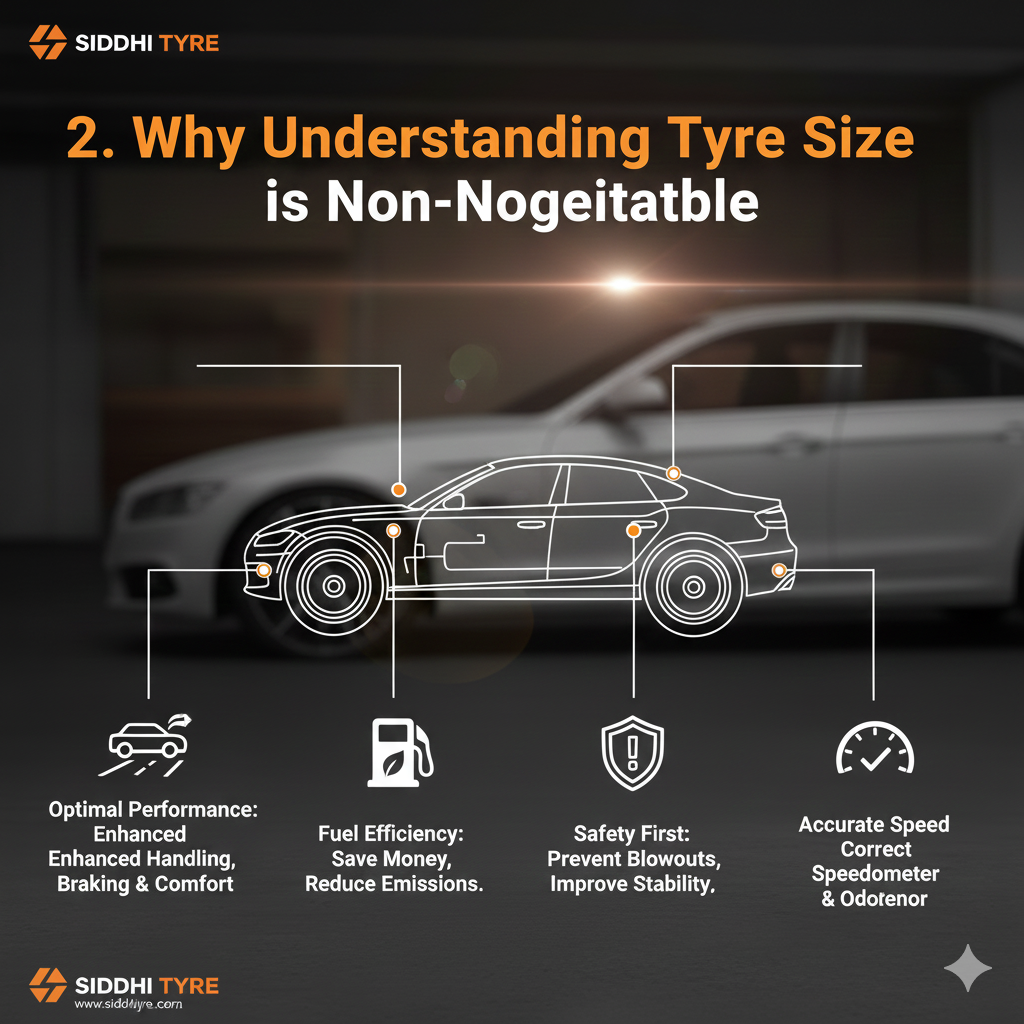
Knowing these numbers isn’t just for mechanics; it directly impacts your daily drive:
- Optimal Performance: The right size ensures your car’s suspension, steering, and braking systems work as designed. Incorrect sizes can make your car feel sluggish, unstable, or even dangerous.
- Fuel Efficiency: An incorrect tyre size can throw off your speedometer and odometer, leading to inaccurate fuel consumption readings and potentially higher fuel costs.
- Safety First: Matching the load index and speed rating to your vehicle is paramount. Overloading or overspeeding on an improperly rated tyre dramatically increases the risk of a blowout. 💥
- Accurate Speedometer: Changing overall tyre diameter without calibration will make your speedometer read inaccurately, leading to potential speeding tickets or misjudged distances.
- Insurance & Warranty: Using non-recommended tyre sizes can void your vehicle’s warranty or even affect insurance claims in case of an accident.
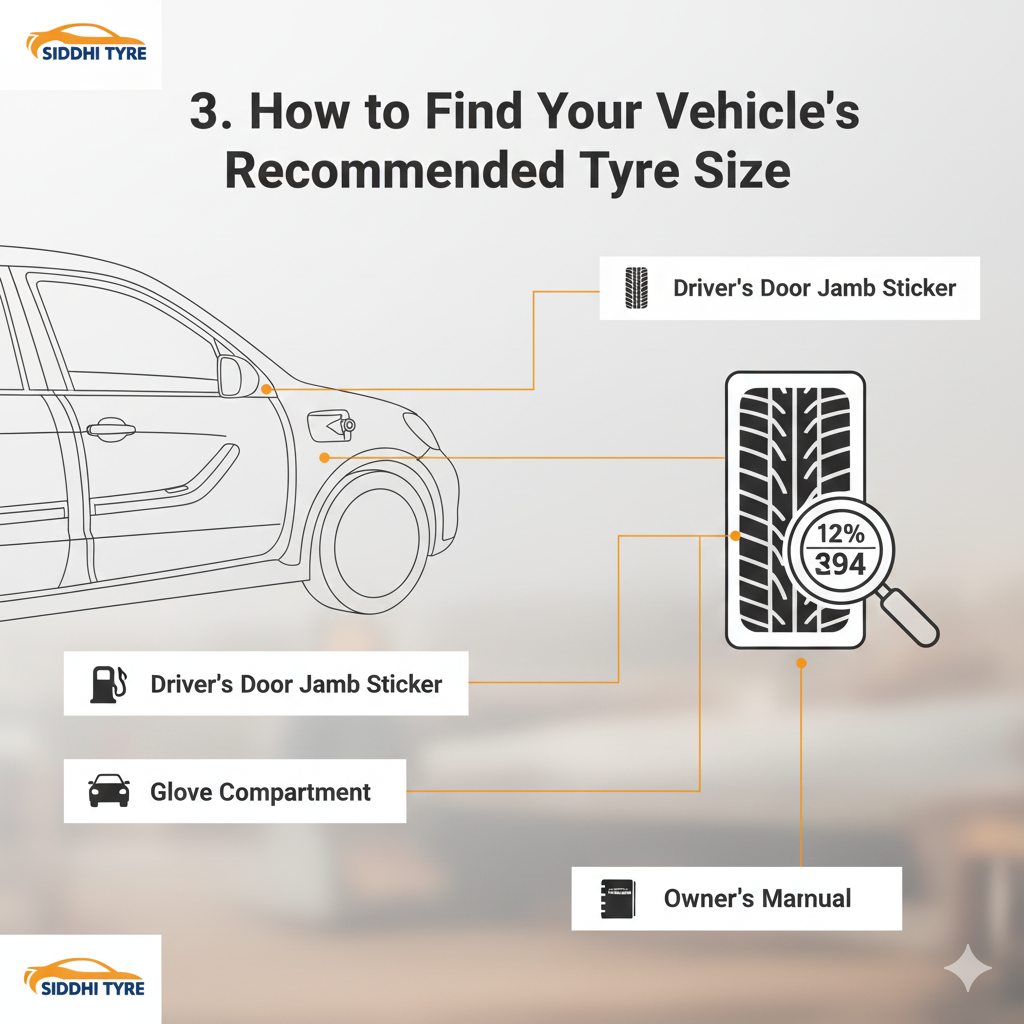
No guesswork needed! Your car’s manufacturer provides this essential information in a few easy-to-find places:
- Driver’s Side Door Jamb: Look for a sticker on the inside of the driver’s side door frame.
- Glove Compartment: Some manufacturers place the sticker here.
- Owner’s Manual: Always the definitive source for all vehicle specifications.
- Fuel Filler Door: Occasionally found here.
Always stick to these recommendations for the best results! ✅

While sticking to factory recommendations is ideal, some modifications are possible, but only with expert guidance:
- Plus-Sizing: Installing larger diameter wheels (e.g., from 16″ to 17″) often involves using tyres with a lower aspect ratio to maintain a similar overall tyre diameter. This can enhance handling and aesthetics but must be done carefully to avoid rubbing or affecting ride quality.
- Winter Tyres: Sometimes slightly narrower tyres are chosen for better grip in snow.
- Off-Road Tyres: For serious off-roading, larger, more aggressive tyres might be fitted, often requiring suspension lifts and fender modifications.
When NOT to Deviate:
- Never install tyres with a lower load index or speed rating than recommended.
- Avoid changes that cause tyres to rub against fenders or suspension components.
- Ensure the overall tyre diameter remains within 3% of the original to prevent speedometer errors and transmission issues.
Conclusion: Drive Smart, Drive Safe with Siddhi Tyre
Understanding tyre sizes is a powerful tool in your automotive knowledge arsenal. It’s not just about compliance; it’s about making informed decisions that enhance your driving experience, protect your investment, and, most importantly, keep you and your loved ones safe.
At Siddhi Tyre, we believe every driver deserves to feel confident and secure on the road. Now that you’ve decoded the numbers, you’re ready to make the smartest choices for your vehicle.
🚀 Ready to Equip Your Vehicle with the Right Tyres?
Have questions about your specific tyre size or looking for the perfect replacement? Our experts are here to help you navigate the options and ensure you get the best fit for your car and driving style.
| Service Type | Action Link |
| 🟢 WhatsApp Support | Chat with an Expert Now |
| 📞 Direct Hotline | Call +91 90822 61908 |
| 🌐 Official Website | Visit siddhityre.com |
| 📦 B2B & Wholesale | Siddhi Tyre on IndiaMART |
1. Internal Links (Siddhi Tyre Website)
Use these to help your SEO and lead customers to your business pages.
- Homepage:Siddhityre.com
- Where to use: In the “Conclusion” or under the “About Us” section.
- WhatsApp Support (Internal Direct Link):Chat on WhatsApp
- Where to use: Use this for your Call to Action (CTA) buttons at the end of the article.
- IndiaMART Product Page:Siddhi Tyre Catalog
- Where to use: When mentioning specific tyre brands or replacement options.
2. External Links (Authority & Trust)
Linking to these official organizations tells Google your content is accurate and safe.
- ATMA (Automotive Tyre Manufacturers’ Association):Tyre Safety Guide
- Context: Link to this when discussing Section 2 (Why Understanding Tyre Size is Non-Negotiable) to prove safety standards.
- ITTAC (Indian Tyre Technical Advisory Committee):Indian Tyre Standards
- Context: Link to this in Section 1 when explaining technical terms like Load Index or Speed Rating.
- Ministry of Road Transport and Highways (MoRTH):Road Safety Guidelines
- Context: Use this when mentioning the importance of following manufacturer recommendations for highway safety.
3. How to add them to your Article (Example):
“According to Tyre Safety Standards by ATMA, maintaining the correct tyre size is critical for braking distance. If you aren’t sure which size fits your vehicle, you can always consult with our experts at Siddhityre.com for a free professional inspection.”